Manual QA that catches what automation misses
Exploratory, regression, smoke, and user-acceptance testing focused on how real people actually use your product — with clear, reproducible bug reports your team can act on immediately.
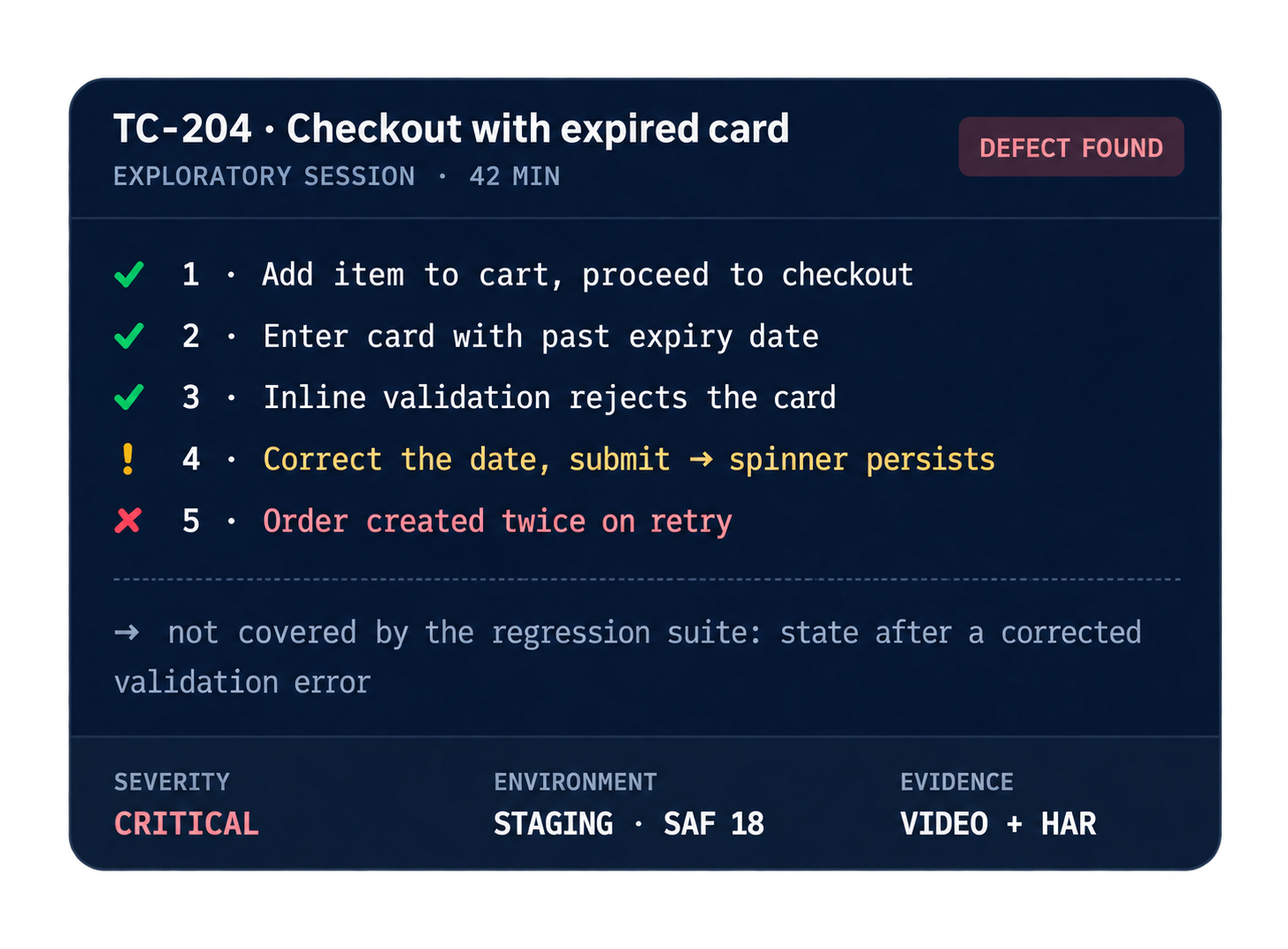
- Exploratory testing for edge cases scripts don't catch
- Regression & smoke testing before every release
- Clear, reproducible bug reports
Manual Testing
Human judgment where automation falls short
Automated scripts are excellent at repeating known checks — they're far less good at noticing that a layout feels wrong, a flow is confusing, or an edge case nobody thought to script for. Manual QA brings a tester's judgment to your product: real exploration, real devices, real user scenarios.
Testing2GO runs manual QA as a structured discipline, not ad-hoc clicking around. Every session follows a test charter or test case set, every issue is documented with steps to reproduce, and findings are prioritized by user impact.
- Exploratory testingStructured, charter-driven exploration that surfaces issues scripted tests don't catch.
- Regression & smoke testingConfirms existing functionality still works before and after every release.
- User acceptance testing (UAT)Validates the product against real user workflows and business requirements before sign-off.
Real user perspective
Testing driven by how people actually use your product, not just what a script checks.
Regression coverage
Critical flows re-verified every release so fixes don't reintroduce old bugs.
Clear bug reports
Steps to reproduce, screenshots, severity, and environment for every issue found.
Release sign-off support
UAT sessions structured around your acceptance criteria, not guesswork.
Testing Types
Manual Testing Coverage
Different points in your release cycle call for a different kind of manual pass.
Exploratory testing
Unscripted, charter-driven exploration to surface issues automated and scripted tests miss.
Regression & smoke testing
Focused passes confirming critical flows and recent changes work before and after release.
User acceptance testing
Structured validation against real workflows and acceptance criteria ahead of sign-off.
Testing Approach
How a manual QA pass runs
Charters & test cases
- Test charters for exploratory sessions
- Test cases mapped to critical user flows
Cross-browser & device coverage
- Desktop browsers — Chrome, Firefox, Safari, Edge
- Real iOS & Android devices
Defect tracking
- Logged directly in your tracker — Jira, Linear, GitHub
- Severity and priority assigned to every issue
What You Get
Manual QA test report
The key sections included in every manual QA engagement.
Test summary
Session count, issues found, and headline risk areas.
Detailed bug reports
Steps to reproduce, screenshots, severity, and environment for every issue.
Exploratory charters
What was explored, what was covered, and open questions.
Regression results
Pass/fail status for every critical flow re-tested.
UAT sign-off notes
Acceptance criteria checked against real workflows.
Browser/device matrix
Coverage across the browsers and devices tested.
Prioritization
Issues ranked by user impact and severity.
Retest confirmation
Verification that reported fixes actually resolved the issue.
Scope & limitations
What was covered and any constraints that shaped the results.
Accelerate quality assurance with AI while keeping human expertise at the center.
I use AI to generate test cases, identify edge-case scenarios, streamline documentation, and reporting, while validating results through critical thinking and business understanding.
- No AI-generated case enters the suite unreviewed
- Every defect reproduced by hand before it's filed
- Your code and data stay out of public models
FAQ
Manual QA testing — FAQs
What is manual QA testing?
Manual QA is hands-on testing performed by a person rather than a script: exploring the product, following test cases, and evaluating how it actually behaves for real users, then documenting any issues found with clear reproduction steps.
What's the difference between exploratory testing and scripted testing?
Scripted testing follows a predefined set of steps and expected results. Exploratory testing is charter-driven and unscripted — the tester actively investigates the product, following up on anything suspicious, which surfaces issues a fixed script would never think to check.
What's the difference between regression and smoke testing?
Smoke testing is a quick pass confirming the build's critical paths work at all before deeper testing begins. Regression testing is a broader pass confirming that existing functionality still works correctly after changes, fixes, or new features.
What is user acceptance testing (UAT)?
UAT validates the product against real user workflows and business requirements before release sign-off, confirming it does what stakeholders actually need, not just what the technical spec says.
Do you combine manual QA with test automation?
Yes. Automation covers repetitive, well-defined checks efficiently; manual QA covers exploratory judgment, usability, and edge cases automation isn't suited to. Most engagements combine both for full coverage.
What do I receive in the report?
A test summary, detailed bug reports with reproduction steps and screenshots, exploratory session notes, regression results, UAT sign-off notes, a prioritized issue list, and a scope-and-limitations section.
Let's put real eyes on your product.
Automation catches what you scripted for. Manual QA catches what you didn't. Tell me about your release and I'll help you ship with confidence.
Contact Us